Hard water is caused by water absorbing dissolved minerals as it moves through the ground.
Hard water is caused by water absorbing dissolved minerals as it moves through the ground. Here’s how it happens:
The process:
- Rain falls as naturally soft water (slightly acidic due to dissolved CO₂)
- It seeps into the ground and flows through rock and soil
- As it passes through certain rock types, it dissolves minerals — mainly calcium carbonate and magnesium carbonate
- These dissolved ions remain in the water as it’s collected in aquifers, rivers, and reservoirs
Rock types that cause it:
- Limestone and chalk are the main culprits; highly soluble and rich in calcium carbonate
- Dolomite contains both calcium and magnesium carbonates
- Gypsum contributes calcium sulphate
Two types of hardness:
- Temporary hardness — caused by dissolved calcium bicarbonate. Can be removed simply by boiling the water, which causes limescale to precipitate out (hence the furring in your kettle)
- Permanent hardness — caused by calcium sulphate and other salts that don’t break down with boiling; requires other treatment methods like water softeners or ion exchange
Geography is key — areas built on chalk and limestone (like much of the Midlands, East Anglia, and South East England) have hard water, while areas with older, harder igneous rock (Scotland, Wales, the Lake District) tend to have soft water.
Hard water is water that contains high concentrations of dissolved minerals, primarily calcium and magnesium ions.
Why it is a problem:
- Limescale buildup — leaves white, chalky deposits on kettles, pipes, taps, and appliances, reducing their efficiency and lifespan
- Soap inefficiency — reacts with soap to form a sticky “scum” rather than a good lather, meaning you need more soap or detergent
- Skin and hair — can leave skin feeling dry and hair feeling dull or stiff after washing
Hardness is measured in milligrams per litre (mg/L) or “degrees of hardness.” Water above roughly 120–180 mg/L is generally considered hard.
Soft water, by contrast, has low mineral content and lathers easily — common in areas with granite bedrock (much of Scotland and Wales, for example). The East and South of England tend to have notably hard water due to chalk and limestone geology.
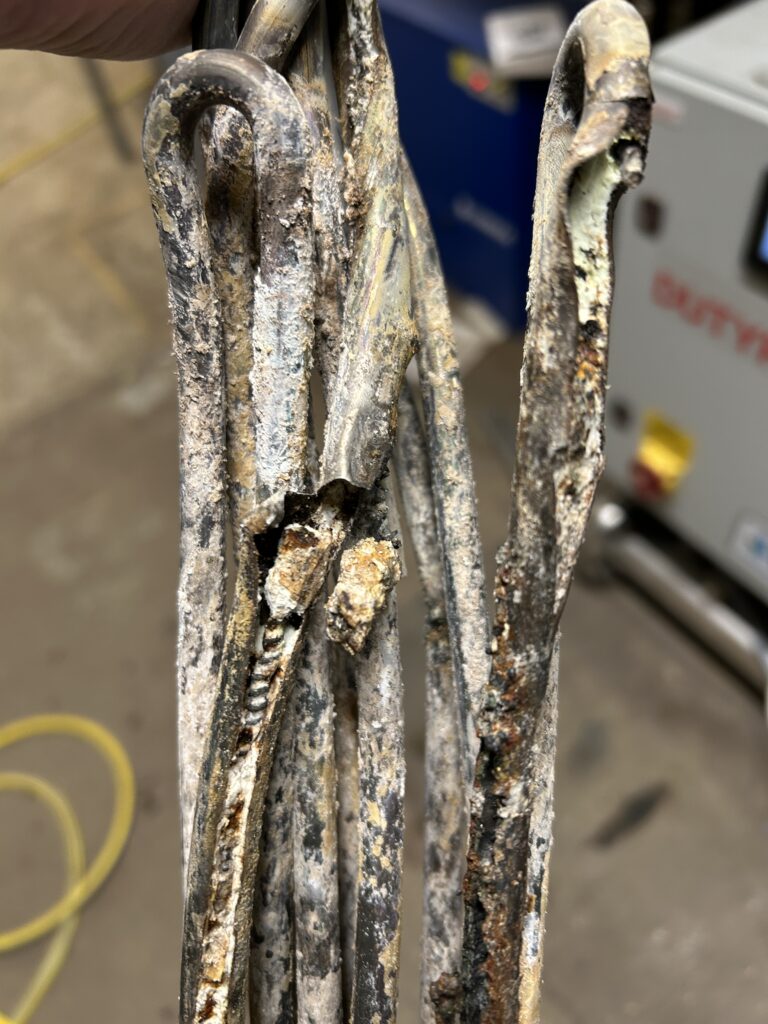
Hard water isn’t a health concern — the calcium and magnesium it contains are actually beneficial minerals — but it’s a practical nuisance in the industrial process, doing this to your heaters –
Leave a Reply