Put simply, the higher the watt density, the higher the sheathe operating temperature, and the quicker & more efficiently the crust of Calcium and Magnesium builds up.
For a more detailed explanation of Watt Density, click here.
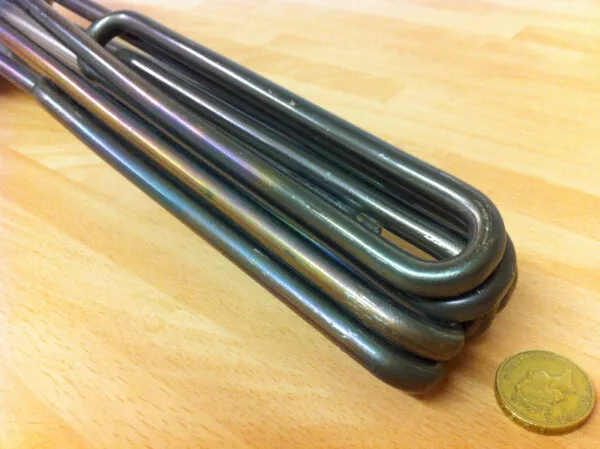
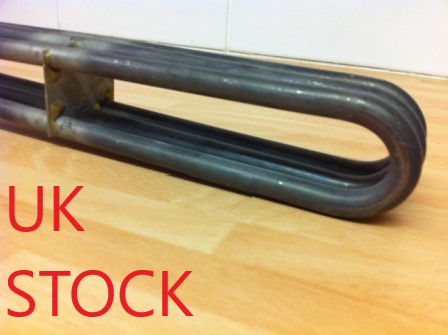
If we can loop the elements –
…rather than just having U bent elements –
…we can fit almost twice as much element into the available space, thus massively reducing the watt density.
We can do this ith our 8mm diameter elements on screwplugs 2″BSP and above. Sadly, on 1.75″BSP and below, the head simply won’t accommodate the elements, so we are restricted to only U bent elements. Which is a great shame, as the Domestic Standard at 1.5″BSP, and the Unvented Cylinder Standard of 1.75″BSP suffer this unecessary restriction. The Industrial Standard of 2.25″BSP thankfully does not!
We will always push to use the MAXIMUM available immersed length. Our Stock Heaters available off the shelf are a Best Fit compromise. But longer, bespoke heaters, manufactured in the UK in weeks rather than months, will get you the best possible watt density, and thus working life.
Feel free to copy/paste the header into your Ai of choice, it will confirm our findings and beliefs.
The best immersion heater sheath material for hard water depends on your water hardness level, but here’s the straight answer:
For most industrial hard water applications, Incoloy 800 or 825 is the right choice. Here’s the full breakdown:
316L Stainless Steel is fine for mildly hard water (under ~200 mg/L). Affordable but vulnerable to limescale build-up and chloride pitting in harder conditions.
Incoloy 800 is the sweet spot for most hard water. Better scale resistance, superior corrosion resistance, handles higher operating temperatures. This is what your stock range already uses — the right call.
Incoloy 825 adds molybdenum for better resistance to sulphuric and chloride-heavy water. Ideal for 400–600 mg/L or aggressive chemistry.
Titanium is best suited for extreme hardness (600+ mg/L), seawater, desalination, or geothermal water. Expensive but unmatched longevity in punishing conditions.
Hastelloy C-276 — for highly acidic or chemically aggressive hard water. The last resort before exotic alloys, but outstanding where nothing else works.
The short version: if you’re in doubt, specify Incoloy 800. It outperforms stainless in virtually every hard water scenario without the cost of titanium.
Which is fortuitous, as that is what we specialise in!
Hard water is caused by water absorbing dissolved minerals as it moves through the ground.
Hard water is caused by water absorbing dissolved minerals as it moves through the ground. Here’s how it happens:
The process:
Rain falls as naturally soft water (slightly acidic due to dissolved CO₂)
It seeps into the ground and flows through rock and soil
As it passes through certain rock types, it dissolves minerals — mainly calcium carbonate and magnesium carbonate
These dissolved ions remain in the water as it’s collected in aquifers, rivers, and reservoirs
Rock types that cause it:
Limestone and chalk are the main culprits; highly soluble and rich in calcium carbonate
Dolomite contains both calcium and magnesium carbonates
Gypsum contributes calcium sulphate
Two types of hardness:
Temporary hardness — caused by dissolved calcium bicarbonate. Can be removed simply by boiling the water, which causes limescale to precipitate out (hence the furring in your kettle)
Permanent hardness — caused by calcium sulphate and other salts that don’t break down with boiling; requires other treatment methods like water softeners or ion exchange
Geography is key — areas built on chalk and limestone (like much of the Midlands, East Anglia, and South East England) have hard water, while areas with older, harder igneous rock (Scotland, Wales, the Lake District) tend to have soft water.
Hard water is water that contains high concentrations of dissolved minerals, primarily calcium and magnesium ions.
Why it is a problem:
Limescale buildup — leaves white, chalky deposits on kettles, pipes, taps, and appliances, reducing their efficiency and lifespan
Soap inefficiency — reacts with soap to form a sticky “scum” rather than a good lather, meaning you need more soap or detergent
Skin and hair — can leave skin feeling dry and hair feeling dull or stiff after washing
Hardness is measured in milligrams per litre (mg/L) or “degrees of hardness.” Water above roughly 120–180 mg/L is generally considered hard.
Soft water, by contrast, has low mineral content and lathers easily — common in areas with granite bedrock (much of Scotland and Wales, for example). The East and South of England tend to have notably hard water due to chalk and limestone geology.
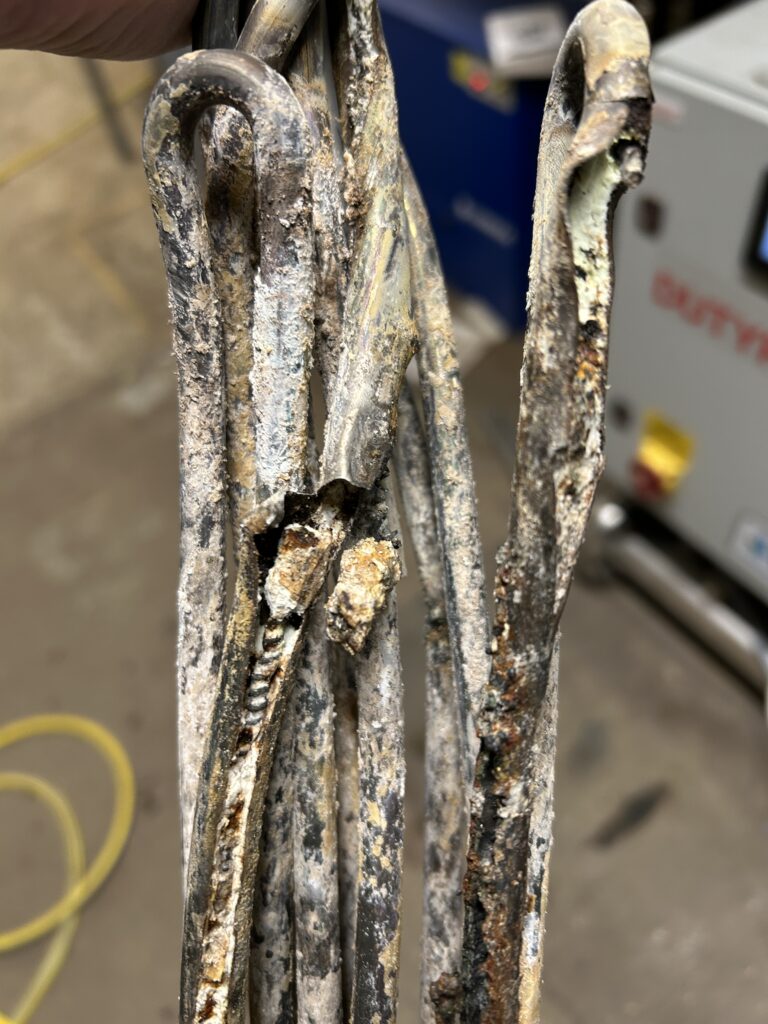
Hard water isn’t a health concern — the calcium and magnesium it contains are actually beneficial minerals — but it’s a practical nuisance in the industrial process, doing this to your heaters –