
Hard Water Is An Ongoing Worldwide Issue.
Hard Water Immersion Heaters, engineered specifically to resist scale, corrosion, and mineral build-up, wherever in the world you operate.
Internal Links list
- The Problem & How We Address it
- Sheathe material
- Watt Density
- Scheduled Maintenance.
Designed & Manufactured Specifically for Hard Water Conditions
Hard water is tough on standard heating equipment. Limescale builds up fast, corrosion takes hold, the heat can’t dissipate and these deposits quietly strangle efficiency, until your heater goes bang, generally at the worst possible moment!
At HardWaterImmersionHeaters.com, we specialise in immersion heaters designed from the ground up to handle exactly these conditions. Whether you’re dealing with moderately hard supply water or extreme mineral content in industrial process applications, we have a solution that keeps working long after standard heaters have expired.
Backed by the expertise of ImmersionHeaters.uk, a trusted UK Limited company, backed by decades of industrial heating experience. Every heater we supply is built to perform in the real world.
The Problem & How We Address it.
Simply put, water in natures own Water Cycle picks up mineral (calcium, magnesium, et al) content from the rocks (limestone, chalk, and gypsum) it flows through, on its merry way into our domestic water supply.
Heating appliances such as kettles and immersion heaters don’t like this mineral content. Because the hot bits are running at hundreds of degrees, the “stuff” in the water tends to stick to the hot surface. This stops the heat dispersing into the solution, so the surface temperature gets even hotter, so more stuff sticks. And so on, like a snowball rolling down a hill. Until eventually the temperatures get so high that it goes pop. Usually at the worst possible moment, as the Universe has a sense of humour.
The Stoics tell us to focus only on what we can control, and as we cannot change the water quality in hard water areas, there are measures we can take to negate it’s effects.
Sheathe material.
Ask Google or your Ai of choice “What is the best sheathe material for hard water?” and you will likely get something like this –
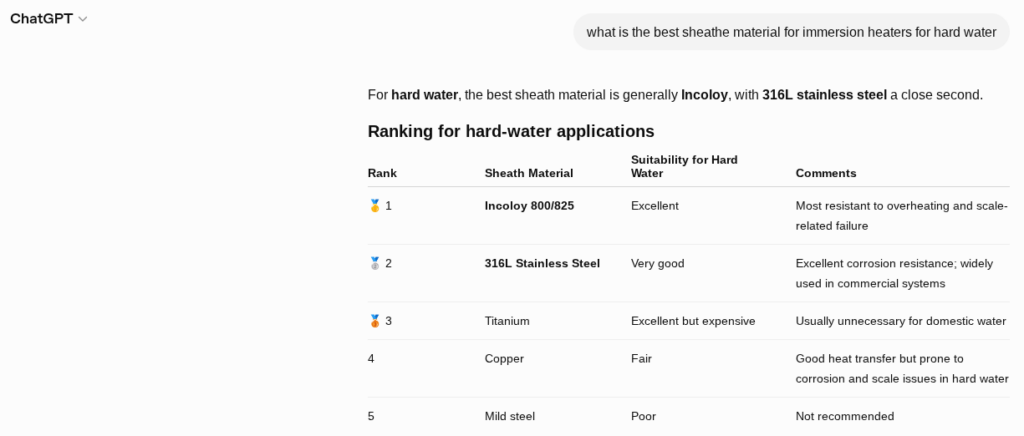
…so we use Incoloy800 (“a widely used iron-nickel-chromium superalloy”) and titanium (“a strong, lightweight, and highly corrosion-resistant chemical element”) for our element sheathes.
Watt Density.
Watt density is the other crucial factor in working life. It is the amount of heating power in watts being emitted from every square inch (w/in² ) or square centimeter (w/cm²) of the hot part of the element. The higher the watt density, the higher the sheathe temperature, the more “stuff” sticks, thus the heat can’t dissipate into the solution, so more stuff sticks, and the quicker it dies.
In an attempt to negate this, we will always ask you what your MAXIMUM immersed length is. And we will always use looped elements, rather than just U bent elements. This enables us to get the most element into the space available, in an attempt to reduce the watt density, delay the onset of crust build up, and extend the working life. Sadly, on screwplugs less than 2″BSP, only U bent elements can be fitted. Hence why we stick to the industrial standard of 2.25″BSP wherever feasible.
Scheduled Maintenance.
When we have addressed all of the above issues, and made you the best heater for your local circumstances, we can then “Prevent Rather Than Cure”.
Sadly, here in the Real World, things only get fixed when they are broken. We deal with an awful lot of customers who need their heaters “Yesterday”. We are good, but not that good!
We can get stock heaters out the next day following payment received, and turn around bespoke items in a week or so, busyness levels permitting. BUT that is going to cost you a 50% premium charge, for the privilege of jumping the queue.
We think that the best way is to Prevent the Panic. If we can liase and tie down the anticipated working life of your heaters, we can manufacture replacements to be onsite BEFORE it hits the fan.




